
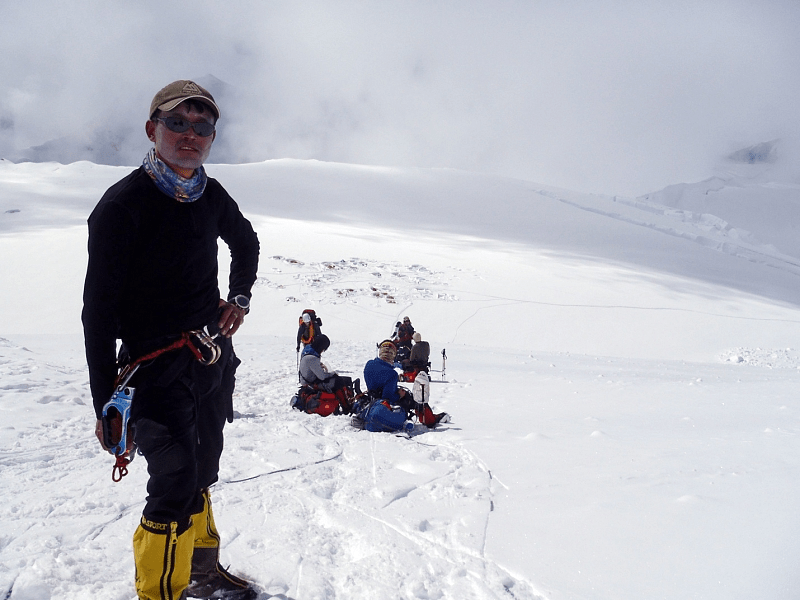
29,032 feet. Mountain peaks through the clouds without an end in sight. That’s something you don’t see in Texas.
Could I run the height of Mount Everest in my local neighborhood? This idea got in my head a few months ago. I had always wanted to climb Mt. Everest in my life and lacked only two things to get me there. Hard core commitment to a training plan over a long period of months (potentially years) and tens of thousands of dollars. The average price is estimated to be around $70,000 to take an Everest trip and the time to train lands between 8-13 months. Outside of that, there was nothing stopping me.
Now it was planning time. 8-12 months of training would put my attempt in mid to late 2026 and that would be the smart thing to do. Building a base, getting used to elevation, and committing to a long-term project.
Would I commit to that? Nah. I felt like part of the thrill of whether I could do this or not would be running against the high chance of failure. I bet I could give myself about five months of training beginning at 0 miles per week to be running 40 miles a week for a good base.
How would one found it? Well, I just started a small business and my salary was $0/year. Given how well this blog was taking off, I was still at $0/year. That meant I would be somewhat limited on travel and the budget for this attempt. Many people probably wouldn’t want to put much money into a horrendous hill workout in their own neighborhood so let’s go with a low budget.
If I were to try, my crew would have to be me and maybe a guilty and worried wife. Our cat definitely would not help or care as long as he was fed. The aid station bathrooms would consist of our apartment unit and nature. Additionally, I would need to get to the destination on foot. That makes it possible for most people to replicate the plan as long as you have a bathroom, a loner cat, and someone stressed that you may end up passed out along the side of the road.
So far, I was recommending an affordable budget for a local attempt which wasn’t too bad. I personally would have to ask my Suga-Mama if I could splurge on extra groceries for the week for extra calories. According to a book called The Program by Eric Kapitulik, Jake MacDonald, people burn tens of thousands of calories climbing Everest. I’d just pre-make more sandwiches and definitely make time for nacho stops to compensate.

One (of the many) features of Mt. Everest that is not found in Austin is the lack of oxygen as one climbs. To make a counter argument, Mt. Everest climbers don’t have to deal with humidity like Texans in the summer. I don’t know if it is actually true whether Everest has high humidity or not so I may skip looking up this fact to make myself feel better. I’d just need to accept that I couldn’t replicate this and if I could, the humidity would be torture enough.
The next block for a local attempt to overcome when attempting to summit Everest would be the amount of time it would take for this endeavor. Nepali climber Lhakpa Gelu Sherpa managed to climb Everest in under 11 hours. What a legend. Typical humans take about two months. Now since you probably wouldn’t need to acclimate to different oxygen levels, one would have a bit more freedom amongst the time barrier. Personally, my lack of physique, mentality, and overall athletic ability would push me to a time much longer than 11 hours.
Lastly, one wouldn’t be covering solely elevation, but tons of miles. If you properly trained and budgeted for the real deal, it would be around 43 miles to go up and down that beast. My guess is I couldn’t find a hill that steep in my local neighborhood to be at 43 miles of running. Looking around my area, I would be covering at least 80 miles. It certainly would become my farthest running attempt to date.
After writing this, I wanted to get more precise data. I ran over to the local hill to see what it would take to calculate the mileage and elevation. The local hill is 0.23 miles long at 8.5% grade (Everest is around 15%) and 82 feet of elevation so I would need to run over 350 times up the hill totaling about 84 miles. I’d recommend trying this on a treadmill instead.
Considering all this, it looked like most crazy people would have the chance to run up Everest the local way! I would put my success rate at around 3%. Unless I fuel properly with Jet’s pizza (not an affiliate, I wish) than I would put my chances at 3.5%. Stubbornness will likely be the key strength in getting in the second half mileage and elevation.
I may try this in the winter or spring, we shall see! Think it’s a terrible idea? You may be right but it should be a fun memory to look back on either way.


 Average Runner Paul
Leave a reply to July Monthly Running Report – Injury prevention, 100 Degrees, and More! – Average Runner Paul Cancel reply